Dielectric Constant (Permittivity) Testing of Insulating Materials: Compliance with ASTM D150 & IEC 250
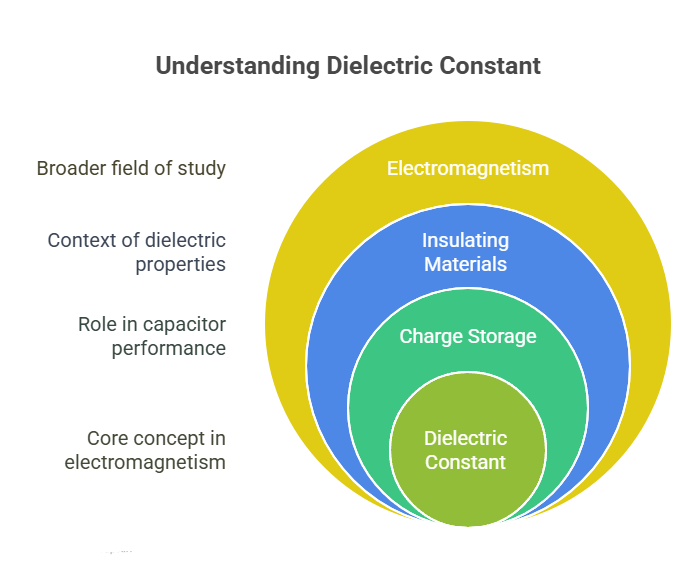
The dielectric constant is the ratio of the charge stored in an insulating material placed between two metallic plates to the charge that can be stored when the insulating material is placed between the same plates with air or a vacuum.
The dielectric constant for a vacuum is 1 and for all other materials it is greater than 1.
Significance:
- When a material is to be use in electric application where high capacitance is needed, a higher dielectric constant is required.
- In many applications insulating materials are required to perform as capacitors. Such applications are best served by plastics materials having a high dielectric constant.
- Insulating materials are used in general in two distinct ways (a) To support an insulate components of an electrical network from each other and from ground. (b) To function as a dielectric of a capacitor.
Test methods: ASTM D-150, IEC 250
Specimen Dimension: The specimens must be in the form of sheet of any size and should have uniform thickness. It must be larger than 50 mm circular electrodes used for the measurement.
Conditioning: Test specimens are conditioned at 23 ± 2°C and 50 ± 5% relative humidity for at least 24 hours prior to testing.
Equipment Details:
Equipment for measurement of dielectric constant is nothing but equipment used to measure the capacitance.
The choice of the method for any particular case will depend upon primarily on the operating frequency.
Test Procedure:
The Methods for measurement of capacitance can be can be done by three methods:
- Null method
- Resonance method
- Deflection method
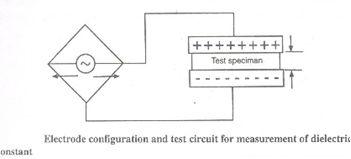
A sample is placed between two metallic plates and capacitance is measured. A second run is made without a specimen between the two electrodes. The ratio of these two value is dielectric constant. The test may be run at standard room temperature and humidity.
Calculation
1. The Capacitance , material as dielectric (C1) is noted.
2. The Capacitance, air or vacuum as dielectric (C2) is noted.
3. Dielectric Constant is calculated by formula (C1/C2).
Factors Influencing:
- Frequency: The changes in Dielectric constant with frequency are produced by the dielectric polarization which exists in the material. The two most important are dipole polarization due to polar molecules and interfacial polarization caused by inhomogenieties in the material.
- Voltage: All dielectric polarizations except interfacial are nearly independent of the existing potential gradient until such a value is reached that ionization occurs in the material or on its surface or that breakdown occurs. In interfacial polarization the number of free ions may increase with voltage and change both the magnitude of polarization & its relaxation frequency.
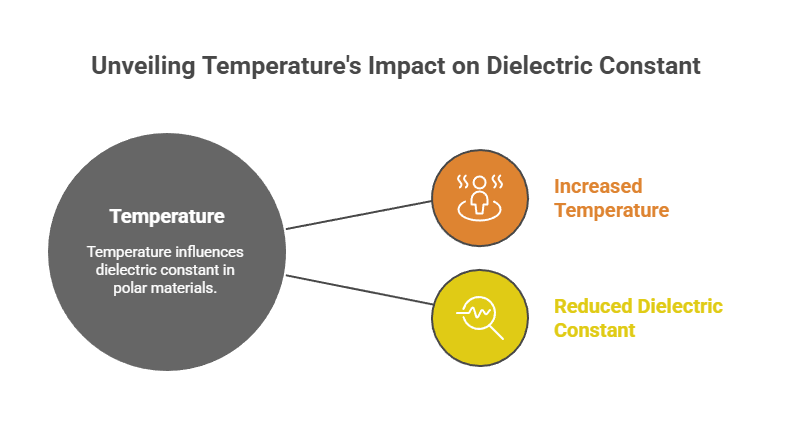
- Temperature: The major electrical effect of temperature on an insulating material is to increase the relaxation frequencies of its polarizations.
- Humidity: The major electrical effect of humidity on an electrical material is to increase greatly the magnitude of its interfacial polarization, thus increasing the dielectric constant. These effects of humidity are caused by absorption of water into the volume of the material and by formation of an ionized water film on its surface.
- Water Immersion: The effect of water immersion to an insulating material approximates that of exposure to 100 percent relative humidity.
- Weathering: Weathering being a natural phenomenon includes the effect of varying temperature and humidity, falling rain, severe winds, impurities in the atmosphere and the ultra violet light, heat & sun. Under such conditions, the surface of the of insulating material permanentally changed , physically by roughening and cracking and chemically by the loss of more soluble components by the reaction of the salts, acids & other impurities deposited on the surface.
- Deterioration: Under operating conditions of voltage & temperature, an insulating material may deteriorate in electric strength because of the absorption of moisture, physical changes of its surface, chemical changes in its composition and the effect of ionization both on its surface and surfaces of internal voids.
Typical Values of Dielectric Constant
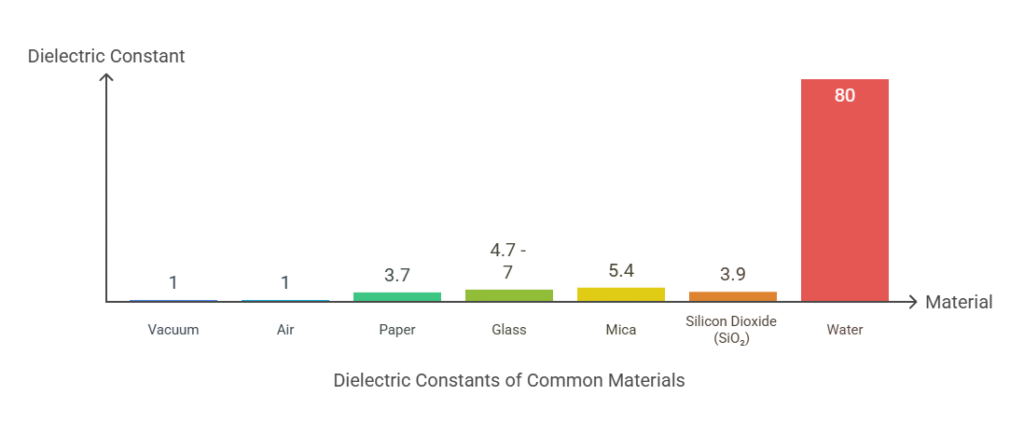
- Vacuum: 1
- Air: Approximately 1
- Paper: 3.7
- Glass: 4.7 – 7
- Mica: 5.4
- Silicon Dioxide (SiO₂): 3.9
- Water: Approximately 80



Post Comment